
Color Your Front Door
October 2, 2009 § Leave a comment
 The front door is your opportunity to give your house some personality and with very little money. Especially if you have a neutral color scheme everywhere else, like we see in this photo from Country Living Magazine (www.countryliving.com/…/budget-makeover-0206).
This beige and brown ranch style home comes alive at the front entryway with a glossy orange door, pumpkin accessories, and wrought iron as the metal for the lights and planters. That’s exactly what I’ve been encouraging homeowners to do on this blog for years.
The front door area is (or should be at least) the real focal point that draws your visitors in. A stunning coordinating color will let your friends and family know which doorbell to ring. Orange is a fabulous accent color — you cannot help but feel happy when you see orange. But other coordinating colors will work just as well.
Take inspiration from the colors in your yard, particularly by the front door. Rich blueberry, eggplant purple, sunshine yellow, and rosy raspberry all make terrific front door colors if you have any of those colors in your garden plantings already. Take time to focus some attention on that front door. It’s the easiest change to make on your house and it will give you a huge impact. If you need some help choosing a front door color, I’m at your service. Just email me at bmeglis@yahoo.com and we’ll set something up.
It’s All About the Windows
May 7, 2009 § 14 Comments
Whether we’re all craving light or fresh air, who knows, but the focus these days is on windows. And we’re not talking about the old standard white replacement models anymore, that’s f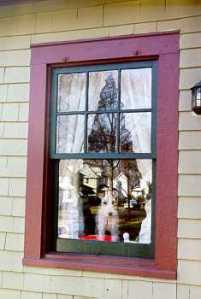 or sure. Now we have choices from black to almond to green and even red. And whatever the shape of your space, we have a window to fit into it. Awhile back the trend was to update the interior lighting plan with recessed cans and spotlights, uplights, downspots, and all the specialized lamps you could imagine for your space. Now we’ve moved on to creating unique window plans to suit the house: clerestory, stained glass, enormous picture windows, and different styles of window mullions to fit the style of your house, from Colonial to Victorian to Mission. Even new homes can be made to look old — well sort of.
Word of caution: If you have an historic home or a home with a very definite style, you should try to repair the original windows before resorting to a replacement. There’s very good information at the following link to help you with windows in historic homes. Or any window decisions, for that matter.
http://www.oldhouseguy.com/windows.php
If you have old wooden windows, paint the window sash and mullions a coordinating color (black looks spectacular) to add life to your home. Those of us stuck with white vinyl are jealous…
My Old House is Just Not Me
August 20, 2008 § 25 Comments
Many of you have a modern aesthetic. You like clean lines, unfussy details, neutral colors, and minimal furnishings. You probably should have moved to a downtown loft space, but you are now part of suburbia. You write in that you’ve decorated the inside of your new home to reflect your taste, but the outside is a disaster.
If you are stuck in an exterior from another era when brick facades were popular and split levels were all the rage, or if some weird architectural detail haunts your house, the easiest and cheapest solution is to paint. For example, if you now own a split level with one-half brick and the other half siding, it’s okay to paint the house all one neutral color to modernize the appearance from the street and actually make the house look bigger since it’s no longer broken up visually.
NOTE: If you own a home that is either listed on your town’s historic register or is in an area of period homes, then do not alter the exterior except to maintain its historic value. Chances are that if you live on the main street in your town and have purchased an older home, the town’s historic commission has already contacted you — they will tell you exactly what you can and more importantly cannot do to your home. Before you renovate the exterior, be careful of “upgrading” to cheaper materials, styleless features, and “modernizations” that will come back to haunt you when you try to sell.
Changing a color palette, however, may be a relatively safe way to modernize without destroying the home’s history. If you live in a colonial but have modern tendencies, you can reflect your modern taste in your house color palette. Choosing three or even four colors off the same paint chip for your siding and trims or painting your house and trim all one color reserving a vibrant shocker for the front door can give even a “boring” (to some) old colonial a modern personality.
Camouflage the Neighbors (and other eyesores)
August 19, 2008 § 1 Comment
 Despite your attempts at diplomacy, your neighbor has decided to park his rusty old camper on your end of his front yard. This predicament is particularly significant if you are trying to sell your house, but it is not pleasant at any time. What to do. If he really will not haul the camper to the rear out of sight, then move on to plan B. Your landscape.
The old saying, “Good fences make good neighbors,” may apply in your case, but if you think that a stockade fence might be a bit aggressive, hedges are the next best thing. Lilacs, forsythia, or a traditional row of arbor vitae will form a quick-growing visual barrier between your property and your neighbor’s.
Eyesores in your own yard can be camouflaged as well. Fencing around a large air conditioner and garbage cans, lattice work around the perimeter of the deck to conceal the yard machinery underneath, a garden of sunflowers between the house and the aluminum shed, and the list goes on. Stand back on the curb or the edge of the property and pretend you are a visitor to your house for the first time. What do you notice in the yard that’s not so great? That’s what needs to be either removed or camouflaged.
Garage Doors Have a New Look
February 13, 2008 § 41 Comments
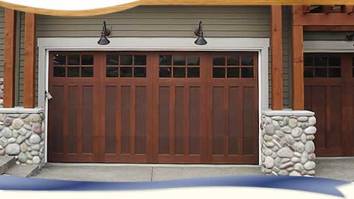 Garage doors rival the front door for attention these days as the look of the garage door becomes increasingly sophisticated and worthy of notice. This particular garage door even has lights trained on it to show off its beauty at night. Who could imagine that the old standard garage doors whose plain and often tennis-ball-dented faces needed camouflaging would be replaced by such distinctive architectural specimens.
Having said all that, please note that if you have one of these carriage doors or plan to get one or two or three, go ahead and show them off. But if your garage still has the garden variety garage door, you are best to paint it the house color with trim color around the outside and refrain from highlighting it. Continue to focus all eyes on your front door.
Curb Appeal: Shrubs, Trees, and Bushes
August 23, 2007 § 2 Comments
 Next time you’re out front, take a good look at your house. Can you see it okay or are there trees and shrubs blocking the view?
It’s especially important if you’re selling your house to make sure potential buyers have a good look at your house from the street. And they like what they see, of course. If overgrown greenery is blocking the windows, the house will look neglected. Red flag to a potential buyer.
Solution: Either hire a landscaper to trim your trees and bushes professionally or give it a try yourself. Just check with a nursery to make sure you prune and shape at the right time of year, but if you’re removing the plant, go for it. If a shrub is woody and without leaves, maybe it’s seen better days.
Fresh landscaping is small and spread out and has a variety of colors and textures. Not all the same green and all the same size and shape. The nursery can advise you, but here’s a tip. If you’re planting something new, pick at least one shrub or bush that coordinates with your house. Red door, red rhododendron. Purple door, lilac bush. Then in the spring, you can stand on the curb and go “Wow!”
Curb Appeal: Porches, Columns, and Color
August 20, 2007 § 15 Comments
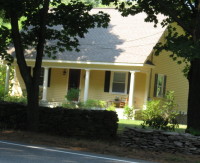 Many farmer’s porches and entryways have supporting columns (or pillars). Some are structural and some are decorative. But even if the builder assures you that those skinny little pillars will hold up the porch and conform to code, the finished look may not appear balanced from the street. I’ve seen many examples of houses where the scale of the column is out of scale with the porch– a big wide porch with dinky little columns (or pillars), one on each end. They look more like toothpicks than architectural elements.
If you have columns or pillars along a farmer’s porch or on either side of an entryway overhang, make sure those columns are substantial. If you have skinny columns, consider adding another to each end so you have two columns on each side of the door. That will provide better balance without any demolition.
For color, paint the columns white or whatever the trim color is on your house. Painting the columns the same color as the front door detracts from both the columns and the door.
Columns can really dress up an entryway. Just make sure they add curb appeal too.
Does Your House Need Shutters?
July 23, 2007 § 163 Comments
If light fixtures are the cuff links of the house, shutters must be a nice silk tie– a great way to add a little more coordinating color to the “outfit.” But sometimes a tie is not necessary and the same goes for shutters.
If your house is a classic colonial with six-over-six, double-hung windows, it is very typical to use shutters, often black. However, if you have a very dark-colored house with cream trim, you may want to skip shutters altogether. Also true for homes that have a lot of stonework or other architectural elements that take the focus off the windows. And contemporary homes with casement windows or odd-sized, mismatched windows usually have no shutters.
One more thing about shutters: If your house has windows with odd placement — too close to the corners, etc. — then forget the shutters. It doesn’t make any sense to use one shutter on one side of the window and none on the other side (I’ve seen it!).
Take a look at your house and look around the neighborhood. Does your house need shutters? Maybe not.
 Your Home & Color Coach