Adding Unexpected Color to Your Home
January 9, 2008 § 16 Comments

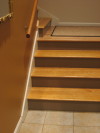
Next time you feel inspired to add color to your home, consider painting the stair risers on your front staircase. Usually they are painted white, a nice contrast against the wooden stair treads, but how practical is that. It doesn’t take long before the riser is all scuffed up with black shoe marks going up the stairs. Why not solve that problem by painting the risers a different color, something darker that will hide the shoe marks but will coordinate with your decor.
You can take a color out of the tile in the entryway or borrow the color from an adjoining room. Either way, the stairs will become a more important feature in your decorating scheme and yet another place to add some unexpected color to your home.
Spring Decorating: Whatever You Like
January 7, 2008 § 17 Comments

Those of us in the decorating business are already studying the spring color schemes and it seems that almost anything goes. We’ve got Barbara Barry’s new soft green and beige palette, a very subtle sophisticated combination similar to the ice blue/chocolate combination we’ve enjoyed over the past few years.
Then there’s Pottery Barn’s red walls with white furniture and bright yellow, orange, and lime green accents, a flashback to the ’70s but with a twist.
Chocolate brown is still hot, and this year we’re adding bold patterned furniture and pillows in place of the textured neutrals of yesterday.
One color that’s making a comeback is dark teal. I’ve seen it paired with burnt orange this time in a strikingly rich paisley fabric from Calico Corners. The look is rich and perfect for a big upholstered chair in a study. I never thought I’d welcome back teal, but it’s looking good.
Ceilings are getting color in a big way this year. Check out the cover of HOME magazine (shown above). They’re showing bright lemon yellow walls and a robin’s egg blue ceiling. I think we’re coming out of our shell, so to speak…
Looking further into the magazine, we find REALLY brightly colored walls of grape, kelly green, classic royal blue, and canary yellow. What makes these colors work is their pairing with bright white. Very crisp and fresh.
White kitchens are back as are white living rooms, again paired with bright accents. There’s just nothing like white for a clean look — people seem to love it.
The organic neutrals are still in, though, especially for more traditional homes so don’t throw everything out. You can always update your look with new accessories like pillows and lamps. But once again, we’re seeing styles and colors for spring that can fit most everyone’s tastes and that’s a good thing.
More soon.
Before You Color Your Walls, Check the Lighting
October 19, 2007 § 12 Comments
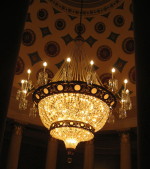 You may not have a chandelier quite as grand as this one for your dining room or entryway, but take a look at your current lighting situation. Although it may seem obvious, good lighting is critical. You need light to see color so before you paint your walls chocolate brown, check to see whether you have enough light in the room to see that gorgeous color. Otherwise it will fade out to gray or black.
You also need adequate task lighting like lamps for reading and pendant lights for cooking. You need some overhead lighting, like recessed cans for highlighting artwork, or chandeliers for mood lighting. But there are other kinds of lighting as well.
Wall sconces are ideal in the bathroom if hung at face level for optimal shaving and makeup application. Sconces are also wonderful for hallways and beside the fireplace to enhance the warm glow in the room. An uplight under a plant in the corner is a quick way to add drama to a room. The light shining up through the plant sends all kinds of interesting shapes onto the ceiling. “Fantasy lighting” creates a mood in a room but is inadequate for actually seeing anything. Soffit lights around the edge of the room give a soft, almost night-light feel to a room. If you’re redesigning a room, look at the lighting first.
Here are a few tips:
- Unless it’s a table lamp, install dimmers on everything from the chandelier in the dining room to the recessed cans in the kitchen. There’s nothing that kills the mood quicker than somebody coming into a room and throwing on the overhead light switch.
- Set up a triangle of lamps. Don’t have all your lighting on one side of the room. Balance it around the room so there aren’t any really dark areas.
- Replace that single bulb in the middle of the ceiling with either a semi-flush-mount light fixture in an up-to-date metal finish or some recessed cans around the perimeter of the room. All on a dimmer.
- Make sure your table lamps are the right scale for your tables. Small lamps are great for the bedroom, but larger lamps really go better in the living room. And tall skinny lamps look good on sofa tables and buffets.
- Don’t forget a floor lamp, excellent for a reading nook.
- And torchieres, like other uplights, throw light up onto the ceiling where it is reflected. Torchieres are a good balance to all the other light that is pointing down into the room.
Have fun with the lighting in your home. You can save money by using energy-efficient bulbs wherever possible, especially in lamps that you leave on a lot. But just remember that those energy-efficient fluorescent bulbs cast a cooler light than either halogens or incandescent bulbs and may change the color of your walls at night. Keep that in mind when you choose your wall color.
Creating a Peaceful Space
October 6, 2007 § 14 Comments
 Sometimes you just want to relax. Whether it’s in a bedroom, a master bath, or some other special place like this library, there are times when you want to enter a room and just say Ahhhhh. When planning that relaxing space, start with the wall color. This room is Gentle Gray (Benjamin Moore) and it reads a very soft blue that is picked up in the carpet color, window shades, and pillows. To add to the earthy Zen feel yet create some warmth, we added a chocolate brown sofa and chair cushions. The texture on the sofa makes it cozy and the silk pillows add some sheen. We topped off the space with satin nickel and glass accents for some sparkle. We kept the accessories spare to avoid visual clutter.
The big tip for creating a peaceful room is to choose colors that are soothing to you and avoid too much contrast that is jarring to the eye. Use texture to add interest instead of bright colors and you’ll have a space you can collapse into at the end of the day.
Curb Appeal: Shrubs, Trees, and Bushes
August 23, 2007 § 2 Comments
 Next time you’re out front, take a good look at your house. Can you see it okay or are there trees and shrubs blocking the view?
It’s especially important if you’re selling your house to make sure potential buyers have a good look at your house from the street. And they like what they see, of course. If overgrown greenery is blocking the windows, the house will look neglected. Red flag to a potential buyer.
Solution: Either hire a landscaper to trim your trees and bushes professionally or give it a try yourself. Just check with a nursery to make sure you prune and shape at the right time of year, but if you’re removing the plant, go for it. If a shrub is woody and without leaves, maybe it’s seen better days.
Fresh landscaping is small and spread out and has a variety of colors and textures. Not all the same green and all the same size and shape. The nursery can advise you, but here’s a tip. If you’re planting something new, pick at least one shrub or bush that coordinates with your house. Red door, red rhododendron. Purple door, lilac bush. Then in the spring, you can stand on the curb and go “Wow!”
Curb Appeal: Porches, Columns, and Color
August 20, 2007 § 15 Comments
 Many farmer’s porches and entryways have supporting columns (or pillars). Some are structural and some are decorative. But even if the builder assures you that those skinny little pillars will hold up the porch and conform to code, the finished look may not appear balanced from the street. I’ve seen many examples of houses where the scale of the column is out of scale with the porch– a big wide porch with dinky little columns (or pillars), one on each end. They look more like toothpicks than architectural elements.
If you have columns or pillars along a farmer’s porch or on either side of an entryway overhang, make sure those columns are substantial. If you have skinny columns, consider adding another to each end so you have two columns on each side of the door. That will provide better balance without any demolition.
For color, paint the columns white or whatever the trim color is on your house. Painting the columns the same color as the front door detracts from both the columns and the door.
Columns can really dress up an entryway. Just make sure they add curb appeal too.
 Your Home & Color Coach