Keeping Up with the Joneses’ House Colors
June 18, 2007 § 8 Comments
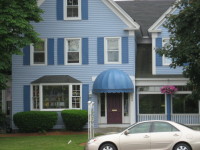 Businesses need to attract attention and this day spa does so in a good way with a very pleaseing cornflower blue color scheme. Some over-55 communities also have similar colorful palettes for their house colors. The builder chooses the colors, of course, but they all go together nicely. One community in New England I saw advertised in the Boston Globe had very brightly colored homes, from sunflower yellow to peacock blue. That’s terrific.
If you live in a community (particularly new construction where you’re not concerned with historic palettes) in which all your neighbors are painting their houses bright colors, and you’d like to follow suit, go for it. When I mentioned in previous posts that your house should fit into its environment, those brightly colored neighbors’ homes ARE part of that environment.
The problem comes when your neighbors all have traditional home colors, white, grey, khaki green, colonial blue, and we come upon YOUR house in a neon salmon. We all like to march to our own drummers, but sometimes it just doesn’t look good. You get the picture.
Stage Your Own Home
June 13, 2007 § 5 Comments
If you are selling your home, or even if you’re not, there is lots of advice out there for how to prepare your house. Television shows like Designed to Sell (HGTV) give you a crash course in updating, but for many home sellers, the thought of redoing kitchens and baths and floors without the benefit of a designer and crew of workers is just too overwhelming.
Here are a few suggestions for staging your own home, enough to get you started, at least.
After 
 Before
Box up all the stuff. You’ve heard it before, but clutter is the biggest turn-off to people who are looking to buy your house. Clutter makes the house feel smaller and it simply makes the house look like yours and not theirs. And you want the potential buyers to see themselves in your house. But you’ve lived in the house for 20 years and accumulated an overwhelming amount of stuff? That’s okay.
1. Start by taking down all the family photos, wrapping them up and putting them in a box labelled “Family: Open First.” You can even put the box in your car and carry it with you. The hardest part is now done. You can now start thinking of your new house as your new home and your current house as somebody else’s.
2. Now create three piles: Keep, Throw Out, and Recycle. Just like the show Mission Organization, take a day and dedicate it to going through your bookshelves, closets, home office, and kitchen with a quick, yet critical eye for what stays and what goes. When in doubt, throw it out. As a general rule, leave lots of open space on the bookshelves, no small knick-knacks anywhere, and as few cords as possible. If you can live without the printer or the DVD player, box it up.
Lighten Everything Up. You’ve removed all the clutter, but everything seems dark. In older homes with lots of dark woodwork, it’s really important to lighten up the room any way you can.
1. Raise all the shades on the windows, push drapes all the way open or remove completely, turn lights on (for a showing), and add white to the room to create some contrast. In this room, we found a bigger piece of art for over the fireplace, moved a white settee next to the fireplace to highlight the room’s focal point, and put a white pillow in the dark blue chair for contrast.
2. Remove all the extra furniture. Keep all the walkways open, bring the furniture away from the walls, and cluster seating to provide intimate conversation areas. In this room, we removed a sofa table that blocked the entrance.
Make it Squeaky Clean. Whether your house is old and worn or brand new, everything in it needs to be clean. Windows, walls, floors, kitchen counters and cabinets, bathroom tile, sinks and tubs. If your walls are dingy, you’ll need a fresh paint job. The potential homeowner should enter a home that smells fresh and looks really, really clean. The same goes with the outside, especially the front door area. Make sure the yard and the front porch are spruced up.
The Rest is Gravy. After de-cluttering, removing extra furniture, and cleaning everything in sight, you’re almost done. Just make sure that each room’s best selling features are evident. If you have beautiful hardwood floors, make sure you can see them (remove unnecessary scatter rugs). If you have a great view, make sure you can see it (maybe even take the drapes down). If you have a terrific marble fireplace surround, call attention to it (put a comfortable chair next to it or a piece of art over it). Put a bouquet of flowers somewhere visible as you come in the front door and let your house sell itself.
Choosing the Perfect Green for your House Color
June 11, 2007 § 11 Comments
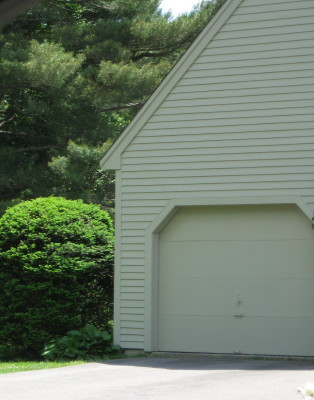
Green is nature’s most prominent color, at least in the spring and summer, and it makes a wonderful color for your house. The challenge is to find the right green, something that appears in nature, does not conjure up images of either toothpaste or lime koolaid, and does not stick out like a sore green thumb. The house at right is somewhere between sage and olive and it definitely works with the landscape around it. The house color does not pop out of the neighborhood and it appears thoughtfully selected.
The house below would be better suited for a more tropical locale, perhaps Key West, where the bright seafoam greens and the sun and fun culture set the landscape’s palette. If you live someplace other than a tropical climate and maybe Southern California, stick with the grayed down shades when selecting a green for your house to blend best with the landscape. Benjamin Moore’s Louisburg green (HC-113), Nantucket gray (HC-111), and Saybrook sage (HC-114) are earthy greens that make terrific house colors.

Consider Your Home’s Roof Color: A Major Design Statement
May 31, 2007 § 385 Comments
Not too long ago, roof color was black — or a shade of black. Today, coordinating roof and house colors or choosing a new roof can be quite a project. So many choices and expensive ones at that. It is important to make a wise decision to avoid a long-term design disaster.
If you’re due for a new roof, congratulations! You now have a chance to select your roof color from the myriad choices that are available. Here are a few guidelines and considerations:
Traditional Shingle Roofs
- Gray or blue house. Stay with a traditional roof color like dark gray or black. That way your roof will blend with your house and make the whole structure seem bigger. Any other roof color will stand out too much and make the house look chopped up.
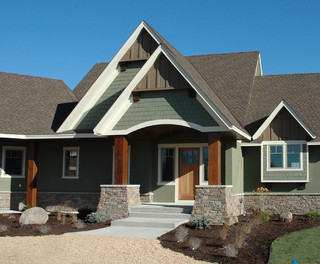
- Cream, tan, or light brown house. Consider the many brown roof options, some of them with a mixture of browns that really make the house look updated and terrific. A brown roof will blend with the cream or tan and make the house look bigger. Black and gray roofs just look ordinary. A brown roof looks like you actually planned out your entire color scheme.
- White house. Dark gray and black are traditional, but they work. Blue is also a terrific option. Red or green metal on a white farmhouse give a traditional country look. Bottom line on a white house: you have lots of options.
- Red, green, or yellow house. You can go either way, a brown or a gray/black roof. I prefer a brown roof for red and green house colors and a black roof for a yellow house.
Of course, the same suggestions apply if you are stuck with your roof color and are looking for a paint color for the house.
- Black/gray roof. The ideal house colors are gray, blue, white, and yellow.
- Brown roof. The ideal house colors are cream, tan, brown, red, green.
- Green roof and other colors. You can either use the roof as an accent color to the house or try to blend it by using a lighter tint of the roof color on the house itself.
Nontraditional Roofs
What about metal roofs? They’re all over Colorado, Upstate New York, and other areas of the world where snow on the roof is a major factor in the winter. Metal roofs come in a rainbow of colors, from red to green to brown to purple. If you have a metal roof, you are making a design statement (whether you mean to or not, of course) and you can treat it as an accent color, kind of like picking a front-door color. However, if you do not want to call attention to your metal roof, choose a natural roof color like dark charcoal, bronze, black, or brown instead of a color like blue.
What about terracotta roofs? These are traditionally seen on Mediterranean style homes and are a definite design feature. Keep the house color neutral to highlight the beautiful roof and the other architectural elements that are undoubtedly present.
Other nontraditional roof materials. Just like a thatched roof on an English cottage, a nontraditional roof is a design feature of the home. Hopefully, you want it that way. Choose a house color that makes the roof look like you planned it as a feature.
Regardless of what kind of roof you have, make sure you consider it when making house color decisions.
Creating a Neutral Living Room
May 29, 2007 § 5 Comments
Neutral doesn’t need to be blah. A neutral color scheme can have color, from tans to greens to blues to light yellows. The big difference between “neutral” and other color schemes is that neutral schemes do not use accent colors that are opposite on the color wheel. For example, in a room with sage green walls, a complimentary color scheme might include a red chair or red pillows on the sofa whereas a neutral color scheme would replace the complimentary color with texture.
Another difference between a neutral scheme and other designs is that neutral rooms tend not to have a mixture of lots of large patterns. Neutral schemes do not want to attract particular attention to one piece of furniture but create an overall restful look.
When you are creating a neutral living room:
- Add Texture. If you are keeping a monochromatic color scheme, whether it’s beige, white, green or blue, you need to create visual interest in the room. And texture is a great way to do that. By adding nubby pillows and a soft mohair throw on the sofa, woven wood blinds on the windows, and a sisal rug on the floor, you have added various textures to the room and created not only tactile but visual interest. The textures stand out against the neutral backdrop.
- Keep your large furniture pieces solid. A large flowered, multi-colored sofa does not lend itself to a neutral color scheme unless the pattern is tone-on-tone (various shades of the same hue). The fabric on the furniture can have lots of texture, however, and even a small pattern. But the sofa needs to read as one color when you stand back. Keeping the large pieces in a solid color allows for maximum versatility. You won’t get tired of them either.
- Use colorful artwork as your focal point. Instead of using color in your furnishings, let colorful art attract all the attention. Just like an art gallery has white walls to highlight the color in the artwork, a neutral background is ideal for featuring an art collection in your living room.
- Add color with your accessories. As a decorator, it’s really fun to use a neutral color scheme and add color with pots, baskets, art, vases, flowers, candles, and collectibles. Then you can change the color with the seasons or when you get tired of it. I like to have winter pillows and summer pillows. My winter pillows are a red Ralph Lauren floral print (kind of stuffy but warm) and my summer pillows are beige and light yellow striped with fringe (fun and carefree looking). And with my neutral living room, I can change the accessories as new colors come into fashion. Much cheaper than redoing the living room every few years.

Consider neutral when a) you’re selling your house (neutral schemes allow buyers to see themselves in your home); b) you live in a small house without much light (a monochromatic color scheme will make the room appear larger); and 3) you like to change your mind about color frequently (instead of repainting and recovering the furniture every few years, change out the accessories only). Neutral color schemes never go out of style. You can add to them and subtract from them as your tastes and home interior styles change.
Color Combos that Add Drama and Curb Appeal
May 25, 2007 § Leave a comment
Whether you are choosing a landscape palette to coordinate with your house colors or giving your living room a fresh kick, contrasting colors give that punch of color that just says Wow.
The colors that are opposite on the color wheel are complimentary — they offer the most contrast and add the biggest pizzazz to your decorating scheme. We already know that adding blue-and-green pillows to a blue sofa will make the colors blend, but adding orange pillows to the blue sofa will make those colors “pop.” And the same is true when you’re planning your front yard landscape.

For example, if you have a blue or blue-gray house with a black door and want to add some drama and curb appeal, consider focusing on oranges and orangey yellows (like Stella de Oro daylilies, for example) in your garden. The complimentary colors enhance each other and make both the house and the garden stand out.
If you have a brick house, the green plantings are really going to stand out. I would suggest using a mixture of greens including some of the yellow-green shrubs (like a jade barberry) and the yellow-green hosta to enhance both the garden and the brick.
If you have a yellow house with a black door, a hot pink rhododendron bush in the front yard will look smashing. You don’t have to use the exact color that is opposite on the color wheel. You can use the colors that are on either side of the opposite color. You’ll still get contrast and a more sophisticated palette.
Use your front door as your inspiration. If you’ve chosen a contrasting color for the front door of your house, say a rusty red on a louisburg green (Ben Moore HC113) house, carry that color into the front yard with a red azalea, a burning bush, and a bed of red tulips.
If you’ve chosen a lighter green house (like prescott green, Ben Moore HC140) and a dark purple door, add a beautiful lilac bush to your yard and other purple shrubs and flowers. This latter color scheme does not use contrasting reds to go opposite the green but adjacent (analogous) colors in the blue and purple family. Although the contrast is not as dramatic, coordinating the landscape and door color still makes an eye-catching curb appeal. The key is to choose plants that bloom at different times so you have continuous color in your yard.
The English garden look with a variety of colors in the garden is traditional and quite lovely. But if you’d like real drama in your front yard landscape, consider sticking to just one color family in the garden. My sister-in-law has a stunning totally blue garden with every kind of blue and blue-purple flower mixed with white flowers to bring out the color. White always enhances color, inside and out.
If your house is white, you have free reign of the color wheel. But my best advice is to select flowers and flowering shrubs that have the same color intensity instead of mixing the bright flowers with the pastels. If you stick with either all bright or all pastel, you can mix all the colors and create a spectacular landscape.
Just a little color planning that extends from the house, trim, and front door colors to the landscape plantings will give your yard that finished designer-inspired look.
 Your Home & Color Coach