
Basement “Man Cave”
July 11, 2009 § 28 Comments
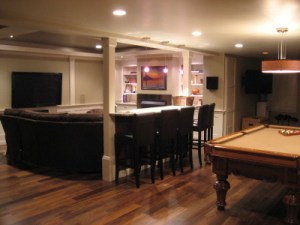 This basement renovation project started with a request for a palette of brown and purple. Coming from a couple with impeccable taste in furnishings upstairs, I knew this would be a fun challenge. We inserted some green into the mix along with a touch of copper and brushed nickel and ended up with more of an upscale version of the typical “man cave” (obviously there had to be two large TVs in the space along with exercise equipment, a bar, a kitchen, and a pool table).
We started with two support beams in the middle of a large space so we built a granite-topped bar between them and divided the space into a media area, a pool table area, and exercise gym.
Instead of putting the large TV on the focal point wall, we decided to build bookshelves flanking a gas fireplace with a metallic tile surround. The Monet print above the fireplace is a nod to “The Thomas Crown Affair,” the homeowners’ favorite movie and the movie of choice on “Opening Night.” The purple and brown leopard print on the little bulbous rocking/swivel chair is my favorite piece in the room. And it’s so comfortable!

It’s All About the Windows
May 7, 2009 § 14 Comments
Whether we’re all craving light or fresh air, who knows, but the focus these days is on windows. And we’re not talking about the old standard white replacement models anymore, that’s f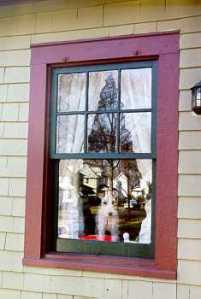 or sure. Now we have choices from black to almond to green and even red. And whatever the shape of your space, we have a window to fit into it. Awhile back the trend was to update the interior lighting plan with recessed cans and spotlights, uplights, downspots, and all the specialized lamps you could imagine for your space. Now we’ve moved on to creating unique window plans to suit the house: clerestory, stained glass, enormous picture windows, and different styles of window mullions to fit the style of your house, from Colonial to Victorian to Mission. Even new homes can be made to look old — well sort of.
Word of caution: If you have an historic home or a home with a very definite style, you should try to repair the original windows before resorting to a replacement. There’s very good information at the following link to help you with windows in historic homes. Or any window decisions, for that matter.
http://www.oldhouseguy.com/windows.php
If you have old wooden windows, paint the window sash and mullions a coordinating color (black looks spectacular) to add life to your home. Those of us stuck with white vinyl are jealous…
Color Your Spirits for the Holidays
December 12, 2008 § 3 Comments
 Remember when the Grinch stole Christmas? All the trees, lights, stockings, and gifts — the trappings associated with a wonderful holiday celebration– were suddenly gone? They had vanished during the night while everyone down in Whoville slept. What happened next in this wonderful Dr. Seuss tale was even more remarkable for its simplicity. Despite losing everything, Whoville didn’t seem to care. All the Whos down in Whoville celebrated anyway.
Of course, the story has a happy ending, but for many people this year, the heartwarming bedtime story has led to a nightmare from which they cannot awaken fast enough. This year it truly feels a little like the Grinch has been here again. With the world-wide recession, job loss, and home foreclosures, many of us around the country are struggling to find that holiday spirit that we used to have and that we desperately want our children to experience in the midst of all this mess.
If you’ve had to cut back this year from your more typical shopping, decorating, and holiday festivities, you are not alone. Keep in mind that gifts can be simple (like homemade cookies), acts of kindness can mean more to people than more stuff, and spending time with our kids is ultimately the gift they’ll remember long past any particular disappointments on Christmas morning.
And to lift our spirits and with the festival of colors inspired by a child’s gingerbread house, let’s all go a little crazy with color this Christmas.
Dig out that snowman sweater from the back of the closet and wear it. Often. It’s going to bring a smile to somebody’s face and that’s a good thing.
String a row of colorful neckties, like garland, from one end of the wall to the other. Your kids will think you’re nuts but who cares?
Fill a big bowl with scraps of colorful ribbons and little balls of leftover yarn and a few silvery mismatched ornaments and display it in the middle of the coffee table. Now you’re getting the idea.
The holidays don’t have to be the way we knew them as kids. Times are different now. But you don’t have to spend much, if any, money at all if you dig deep into your hope chest of creativity for some colorful decorating ideas that will raise your spirits and everyone else’s too.
In Times of Trouble, Paint!
November 25, 2008 § 24 Comments
If you’re hunkering down to wait until economic conditions improve before making changes to your home, just remember that a gallon of paint costs only about $23 (Valspar from Lowe’s). I’ve moved to Valspar from Benjamin Moore (they don’t pay me so I can do that) because the paint is a better value. I hav e been very impressed so far with the quality of the paint, how it goes on the wall, and the ease with which Lowe’s will color-match. If you are trying to save money, and who isn’t, I highly recommend Valspar.
As we spend more time watching the news these days and less time at the shopping mall, a small painting project may be just what the doctor ordered. A gallon of paint can brighten your mood and make you feel like you have control over something in your life, even if it’s just an accent wall behind your sofa. Or try painting the wall behind your bed — you may feel more inclined to MAKE the bed in the morning and that activity alone will give your mood a boost.
A quart of paint will cover your kitchen backsplash. Choose a satin or semi-gloss finish for easy cleaning. With a roll of blue painter’s tape (another inexpensive purchase), you can make stripes or “tiles” on your backsplash and perk up a drab kitchen.
Kids love redecorating their rooms. Changing the paint color and moving the bed can inspire your child to take pride in keeping the room neat. And while you’re moving things around, why not go through the toy chest and decide which toys can move on to other kids.
If the economy has you down, do something fun. Paint!
How Current Events Affect Color and Decorating
September 18, 2008 § 20 Comments
For the past several years, post 9-11, we’ve cocooned in our homes painting them rich warm cozy colors like dark chocolate and rich rusty red, colors that evoke warmth and safety and home. Lately, we seem to be moving out of that intense color phase and into a new light phase with wall color being the first casualty. But I think we’re seeing more than just a design pendulum swing.
Those of us listening to clients and observing the trends are seeing a design fork in the road. One goes to neutral walls (there are millions of “whites” now) and pops of brightly colored hues, a la 1970s for those around then. One example of that is a spectacular room by HGTV’s color guru David Bromstad shown here.

The other is a move toward a palette of soft sophisticated hues all in very light values and all the same value from room to room. The hues may include grays (very hot this year) but also gray greens, warm beiges, light taupe and lavender, and very soft delicate colors that almost defy description. These breathless tints are paired with lots of white and often dark floors, like the photo below of one of designer Chris Barrett’s fabulous bedrooms.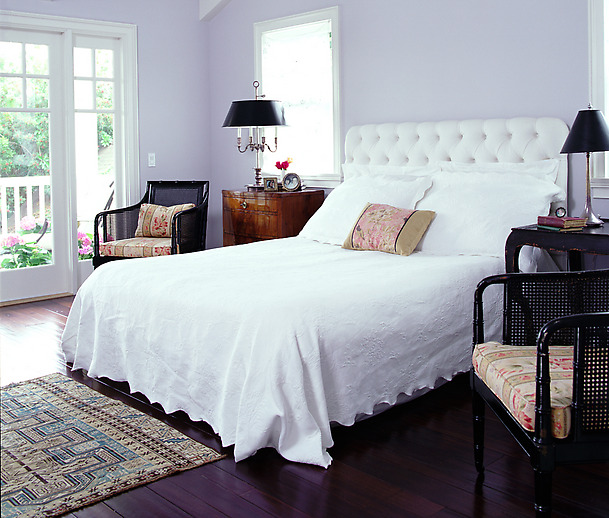
My theory is that people are craving an uplifting light-filled, relaxed, decidedly happy-looking environment to come home to instead of the cozy dark cocoon look from years past. With everything awful in the news, from hurricanes to the stock market, people need visual relief if that’s all the relief they can get. And creating a light cheerful backdrop for the family may be one of the few things left under our control. And paint is relatively cheap when it comes to redecorating.
Note that in many traditional homes where antiques and fine furnishings are featured and where design trends come and go unnoticed, the wall color has always been creamy beige. Providing a very light neutral backdrop to show off all the wonderful items in the room is a traditional approach that will never go out of style. But for those of us who get inspired by color and who feel color and what it does for us and who change wall color almost as often as we refresh our wardrobes, I’ve had it with dark, at least for now. I need light and I’m off to buy primer. I’ll let you know how it goes.
My Old House is Just Not Me
August 20, 2008 § 25 Comments
Many of you have a modern aesthetic. You like clean lines, unfussy details, neutral colors, and minimal furnishings. You probably should have moved to a downtown loft space, but you are now part of suburbia. You write in that you’ve decorated the inside of your new home to reflect your taste, but the outside is a disaster.
If you are stuck in an exterior from another era when brick facades were popular and split levels were all the rage, or if some weird architectural detail haunts your house, the easiest and cheapest solution is to paint. For example, if you now own a split level with one-half brick and the other half siding, it’s okay to paint the house all one neutral color to modernize the appearance from the street and actually make the house look bigger since it’s no longer broken up visually.
NOTE: If you own a home that is either listed on your town’s historic register or is in an area of period homes, then do not alter the exterior except to maintain its historic value. Chances are that if you live on the main street in your town and have purchased an older home, the town’s historic commission has already contacted you — they will tell you exactly what you can and more importantly cannot do to your home. Before you renovate the exterior, be careful of “upgrading” to cheaper materials, styleless features, and “modernizations” that will come back to haunt you when you try to sell.
Changing a color palette, however, may be a relatively safe way to modernize without destroying the home’s history. If you live in a colonial but have modern tendencies, you can reflect your modern taste in your house color palette. Choosing three or even four colors off the same paint chip for your siding and trims or painting your house and trim all one color reserving a vibrant shocker for the front door can give even a “boring” (to some) old colonial a modern personality.
Camouflage the Neighbors (and other eyesores)
August 19, 2008 § 1 Comment
 Despite your attempts at diplomacy, your neighbor has decided to park his rusty old camper on your end of his front yard. This predicament is particularly significant if you are trying to sell your house, but it is not pleasant at any time. What to do. If he really will not haul the camper to the rear out of sight, then move on to plan B. Your landscape.
The old saying, “Good fences make good neighbors,” may apply in your case, but if you think that a stockade fence might be a bit aggressive, hedges are the next best thing. Lilacs, forsythia, or a traditional row of arbor vitae will form a quick-growing visual barrier between your property and your neighbor’s.
Eyesores in your own yard can be camouflaged as well. Fencing around a large air conditioner and garbage cans, lattice work around the perimeter of the deck to conceal the yard machinery underneath, a garden of sunflowers between the house and the aluminum shed, and the list goes on. Stand back on the curb or the edge of the property and pretend you are a visitor to your house for the first time. What do you notice in the yard that’s not so great? That’s what needs to be either removed or camouflaged.
Bring Your Summer Vacation Home: How to Achieve the Cottage Style
August 18, 2008 § Leave a comment
If you own a cottage or rent one somewhere, you know what the cottage style is all about: old painted furniture, vintage fabrics, mixes of woods and different styles of furniture. It’s all about care-free and comfortable living because that’s what vacations are for.

To bring that feeling and more importantly the lifestyle home with you, all you need is a relaxed attitude about your furnishings. Instead of upholstered furniture that warrants surveillance when your children and their friends are around (say nothing of the pets), just invest in some washable custom slipcovers. White is actually best since you can always bleach out the jelly stains if necessary. Cover the expensive sofa and chairs and just feel your blood pressure lowering. You’re relaxing already. And who says wicker is just for porches. A good coat of spray paint will freshen up even the most weather-beaten wicker and make it presentable for your living room.
If you haven’t inherited a cellar full of old furniture that would be perfect for your new relaxed cottage look, then let the furniture hunt begin. Plan what you need, of course, to avoid coming home with impulse purchases, but start the search for the perfect old coffee table, end table, console, buffet, china hutch, whatever you need to create your cottage lifestyle. Visit consignment stores, yard sales, thrift shops, and flea markets. The point is: If you like the piece and it fits, then buy it. If it fits and you don’t like the look, buy it anyway and paint it.
Cottages are typically dumping grounds for old furniture that’s replaced in the permanent home. And to make the furniture look better, it’s often painted. Time and wear rough up the edges on these cottage relics, but you can recreate the look with paint and some sandpaper. You don’t want things to match. Furniture and other items are acquired over time, sometimes decades, so if the piece has a function, it works.
The best part about the cottage style is how comfortable your guests will be when they visit you. No pretense. No uncomfortable questions about where to sit. Your home will feel warm and inviting to everyone.
Updating Old Furniture
July 17, 2008 § 9 Comments
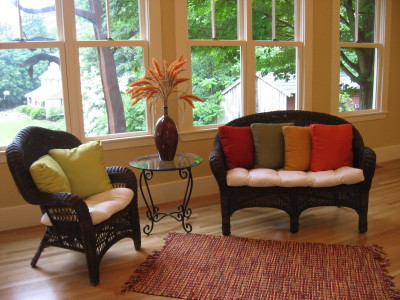 I love a bargain. And if I can get something for free, all the better. I got this wicker settee from a friend moving to a city condo and the chair was a consignment store find. Both original pieces were not so great-looking. The chair was a dingy “white” and the settee a pretty banged-up natural wicker. All it took to update this furniture was two cans of dark brown spray paint and a tarp to cover the grass in the backyard. Within an hour, the furniture had been rescued.
For cushions, I used an inexpensive cotton (even covered some buttons) and splurged on a few new pillows.
Don’t overlook old furniture that can be spruced up with a little elbow grease. It’s really fun and rewarding to take what might have gone to the dump and make it fresh and usable again.
Reviving Old Furniture with Wall Color
May 13, 2008 § 16 Comments
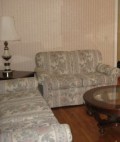 Do you have a sofa from the 80s that looked great back then but kind of looks sad at the moment? Of course, you can slipcover it, but how about punching up the color behind it. We took a living room with blah beige striped wallpaper and pastel patterned upholstery (in good condition) and brought it to life with a soft blue-green paint color (Benjamin Moore’s stratton blue HC-142) and some new pillows. What a difference. All of a sudden the sofas looked intentional and the room came alive.
The trick here is to pick a wall color that is rich but subdued. You need a greyed down shade for this effect to work. Otherwise, a bright wall color might just make your furniture look even older. But a nice tasteful splash of wall color will give your furniture a few more years of life. And in this age of recycling, re-purposing, and reusing old stuff, it’s all about making what you have work.
Before you drag your old furniture off to the consignment store, try painting your room.
 Your Home & Color Coach