
Choosing House Colors: Bark Brown?
February 28, 2012 § Leave a comment
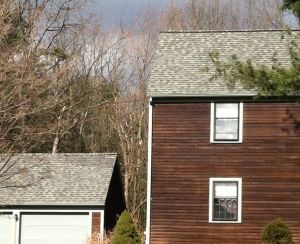 Talk about fitting in! Dark, rich tree-bark brown is about as close to nature as you can get for a house color that will fit unapologetically into almost any landscape.
What I love about this brown house, however, is how creative the homeowners were when it came time to choose a new roof color. Instead of opting for a light brown, gray, or dark forest green (all great options, by the way), they chose a light sage dimensional roof that looks spectacular. Then they pulled the trim color from the lightest shingle tone and used that for trim around the dark brown windows (also a nice touch), the corner trim, and the garage doors.
The result? Something different! How refreshing! Are they locked into a green roof? Yes. But who cares…
Choosing House Colors: Pine-Green?
February 8, 2012 § Leave a comment
 Dark blue-green pine needles and rich cedar mulch present a warm house color palette perfect for homes that want to sit quietly in a wooded environment or at least conjure up the same.
Although much of the leafy countryside in many landscapes is a mixture of greens, notice that most have a yellow undertone. But not pine green. It leans more toward blue and for that reason can really stand out in a grove of maple trees.
To warm up the cool green shade, add brown and no better place than the roof (a gray roof is fine too but it will keep the house cool). Creamy trim provides contrast between the two darker shades and serves to outline the architectural detail (dark trim will get lost but use it if you are seeking camouflage).
For the front door, why not splurge and get solid wood stained a darker version of the roof color or choose a similar paint hue like Maple Syrup (Ben Moore 1105).  Black wrought iron is the best metal for hardware, lighting and accessories.
Once again, nature’s palette does all the work.
Choosing House Colors: Taupe?
January 10, 2012 § 3 Comments
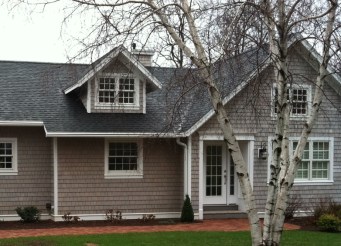 When selecting the palette of colors for your exterior, use natural materials in the environment as your inspiration. This stonework has all the colors you need for your entire house, from the dark charcoal of the roof to the taupey gray siding and even the orangey brick walkway.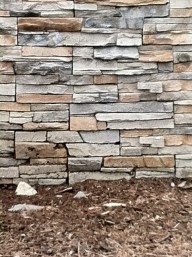
Tying your house color in with its surroundings “grounds” the house — it looks like it belongs there. A house that strays too far from the natural palette looks more like a spaceship that has landed on a foreign planet. Don’t do that to your neighborhood. Save your taste-specific color applications for inside the house.
Sporting a Patriotic Color Scheme
November 7, 2011 § Leave a comment
 With all due respect to my international bloggers, this house sings America the Beautiful to me every time I drive by. This time, I stopped to capture its beauty and share it with you.
What makes this red, white, and blue color scheme work so perfectly is the balance of color between the candy-apple-red siding and the creamy white trim. Notice on the flag hanging on the door that, for the most part, neither the red nor the white stripes dominate. Both colors balance each other. That same effect is evident on this house — the exceptionally wide trim painted a soft cream keeps the red from overpowering the house. Just like the flag, the house is balanced.
Navy blue accents the doors — just like the small block of navy blue in the upper lefthand corner of the flag provides a contrasting backdrop to the white stars.
If you have an old farmhouse or an outbuilding on your property that you would love to feature, consider painting it red with creamy white trim and navy blue doors. Hang the flag out front. You’ll attract attention but go ahead. Be proud!
Choosing Shutters and Trim for Historic Homes
November 1, 2011 § Leave a comment
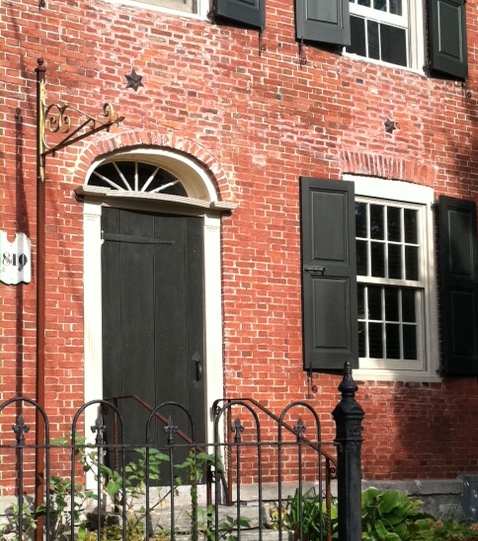 Historic brick homes like this one, built in 1810, have an exterior look to maintain. Many are under the control of town boards that determine what changes can be made to the house. But even if you own an old home or are considering buying one that is not in an historic district, don’t even think about replacing the wood shutters with easy-maintenance vinyl or the wooden front door with fiberglass.
Exterior “upgrades” that only consider the time management issues of the homeowner are not upgrades at all. Instead, embrace your older home and its history. Preserve the look by choosing a paint trim color that is not too new-looking. A gray, beige, or grayed-white will give an aged look to the trim that is appropriate for the age of the house. Charcoal instead of black will give the shutters and door a faded-black look that freshens up the paint job without destroying the look of the house. Use wrought iron or brass for your metal instead of nickel (too contemporary). And use native plants for your landscaping instead of the current, most trendy flowering shrubs.
Buck the urge to over-improve with new man-made materials. Let’s preserve as much history as we can!
Freshen Your House Color: Paint Your Trim
October 21, 2011 § Leave a comment
 Amazing what just a little paint can do to freshen up a house. Just changing the trim color from siding color (beige) to white brought this house from drab to defined. Suddenly the architectural details emerged: the substantial window trim, the fascia and soffit, and the detail around the front door. A simple fix really but effective.
Houses need contrast. When choosing a trim color, select either a 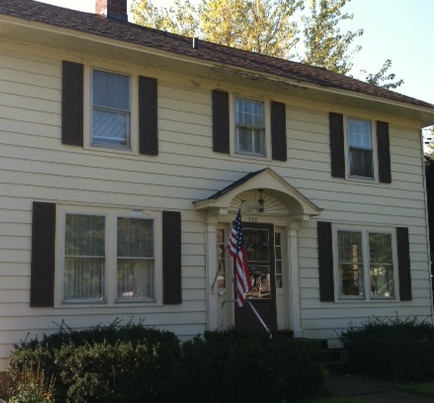 different color from your siding or a different shade of the siding color. Not only will the house be more updated and interesting to look at, but also the house will look as if the entire house was repainted, not just the trim.
Grabbing Attention at the Front Door: How to Pick a Door Color
July 25, 2011 § 12 Comments
 Red, yellow, and blue are primary colors that attract attention. Used alone or in combination, they will definitely grab your eye. So it’s no great surprise that this house with its pale yellow siding, royal blue door, and red foundation plantings made me slam on the brakes for a quick photo.
The first color you notice is the royal blue. That shade is what many would consider to be the definition of “blue” and with the white trim around the door, it pops. And that is precisely what a front door should do. There should be no mistaking the front door for the service entrance (I just love saying that… you know what I mean … usually the door into the garage).
The front door does not have to be a primary color, for sure, but it should stand out significantly enough from the rest of the house to be a welcoming entrance, and there should be a clearly defined path leading up to it. Front doors that, despite their color, are obscured from view behind a large bush just do not function well. I’ve been to some houses that were so confusing that I ended up walking around the house into the back yard looking for the way in… (this happens primarily when there is no sidewalk or stone pathway to follow — the subject of another post).
If you have two doors on the front of your house, be sure to let people know which door is preferable. Plantings, lights, and a visible doorbell or knocker will guide your guests to the preferred entrance and prevent your greeting partygoers in the mudroom. I suggest painting your main entry door the accent color and the other “service” doors the siding color. Then your guests will not be forced to choose between red doors, numbers 1, 2, or 3.
These are little points in the grand scheme of curb appeal, but I just thought I’d mention them anyway.
House Color, Trim, Shutters: Gold Medal Combo
April 7, 2010 § 2 Comments
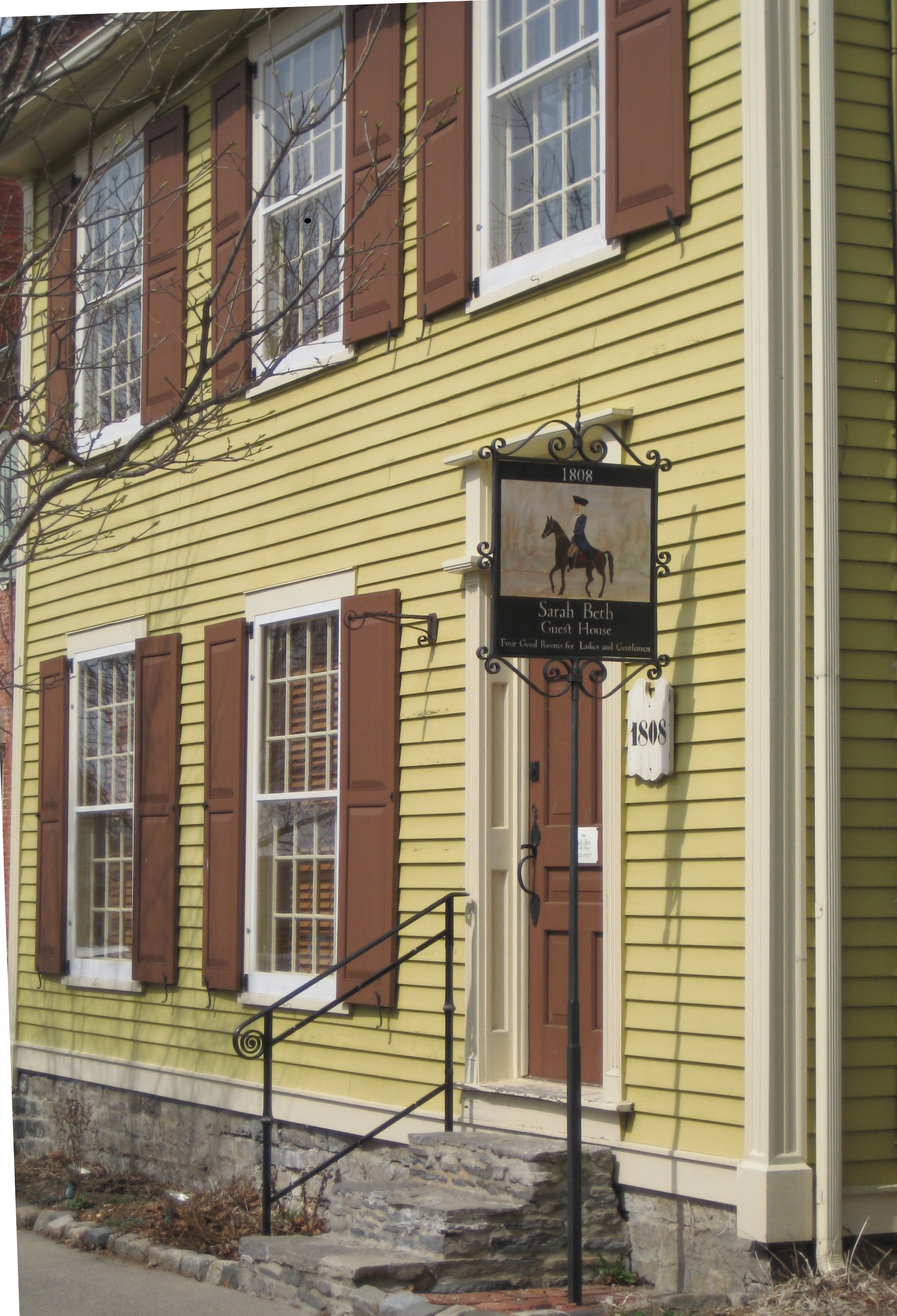 The unexpected color combination on this historic home (now a B&B in Sackets Harbor, NY) really pops off the street. Whether it’s the hint of green in the gold siding, the Jamaican rum-like warmth of the shutters, or simply the combination, I’m not sure. But coupled with cream trim and accents of black, this combination is a winner.
The house color looks like Ben Moore’s Marblehead Gold (HC-11), and the shutters look like a slightly darker version of Copper Kettle (1218). I should have rung the doorbell to ask (I’ve been known to do that).
The stone steps unfold seamlessly from the foundation right onto the sidewalk and the delicate scrollwork in the iron railing ties in beautifully with the sign and even the shutter “dogs.” And for those of you who have asked about using cream window trim with white windows, here’s a great example of how nicely it works.
 Your Home & Color Coach